Student Meals Now Available!

The Steller Parent Group Student Nutrition Committee is pleased to share with our families that The Community Lunchbox will be distributing food, prepared meals and shelf stable boxes (for a family of four) to anyone in need, no questions asked from the Power Center starting this week.

Steller students and their families are welcome to make their way to the parking lot of the Power Centre at 704 W. 26th Ave starting at 1:45 on Monday, Wednesday and Friday. Many families are experiencing food insecurity during these unprecedented times, and we encourage our community members to share this information widely so that no child goes hungry. 

If your family is struggling support is available.  We encourage you to reach out to our counselor Marriane at pedersen_marianne@asdk12.org 


Steller Parent Group Meeting Tuesday!

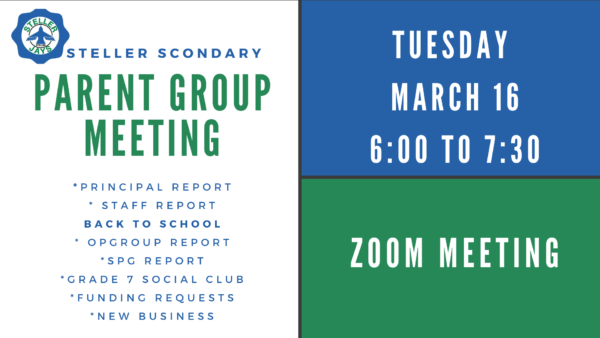
We hope you are having a great week off! Don’t forget Steller Parent Group will be meeting on Tuesday, March 16th at 6:00pm via Zoom. 

This is your chance to hear from Reed and staff about what is happening at school, vote on how Steller Parent Group spends our money, and meet other parents. 

It’s also time to start thinking about forming our Board for next year.  In particular we will be needing a new Treasurer, and many other positions will need to be filled with a return to in person school.  Join us and find out more about how you can help! 

Topic: Steller Parent Group
Time: Tuesday, March 16, 2021 6 to 7:30pm

Join Zoom Meeting
https://zoom.us/j/97391496736?pwd=NVlNbkc4N3Q5REZSMUxqcXFWTmcxZz09

Meeting ID: 973 9149 6736
Passcode: STELLER
One tap mobile
+16699009128,,97391496736#,,,,*7789210# US (San Jose)

Dial by your location
+1 669 900 9128 US (San Jose)

Meeting ID: 973 9149 6736
Passcode: 7789210
Find your local number: https://zoom.us/u/ad29bE9kHX


Steller Students at Model United Nations


The UAA Wendy Williamson is empty in the hours leading up to the Model United Nations in 2018. The conference was held virtually this year (2021). (Photo by James Evans / UAA)

This month students from high schools and universities in Alaska and Washington participated in the 35th Model United Nations Conference hosted by the University of Alaska, Anchorage. Students from Steller represented four countries and participated in six committees. 

A Model United Nations is a simulation of one or more of the bodies of the United Nations. High school students from around the world participate in MUN conferences at the local, national and international level. This year the topic selected at our local level was the COVID Pandemic. 

Participating in MUN means representing a nation state and their positions on a specific topic on the world stage. Preparation often includes research about government, population, demographics, history and current policies in order to fairly represent your countries interests in the United Nations. This often culminates in the position paper, a brief essay describing your country’s history, policy and position on the theme of the conference. The decisions you make in MUN are based upon this paper. For me, one of the hardest things to do at MUN is adopting the mindset of your country’s government, and role playing as an official of that government – especially when I don’t personally agree with the policies of the country I am representing. My natural tendency is to want to give my own opinion about things. However, MUN is about fulfilling a role which isn’t your own, and working with others for the interest of your country and the global community. 

I have learned a lot from participating in MUN conferences around the world – from learning about research skills, to crafting a resolution.  But one of the most important things has been to see how all the rules and regulations in a big organization can be used effectively to get things done, and also how they can be misused and get in the way. I would recommend anyone should give MUN a try! 

Eli P. Senior

Want to learn more about MUN? See here.

Lottery Application for 2021 is now open!

If you would like to view a recording of our Information Night please email Kirsten at chairstellerparentgroup@gmail.com

Steller Secondary School, a part of the Anchorage School District, offers an alternative to standard (large school) education. We have about 200 students in grades 7-12 from the Anchorage area, all of whom attend the program by choice. The primary emphasis is on responsibility to self and to the Steller community. Students, parents, and staff participate in the democratic process of setting school policy and procedures. Students play an integral role in planning activities, from deciding when and where to have dances to what courses should be offered. In addition to participation in the operation of the school, students are encouraged to spend some of their time at Steller in community service in order to learn more about and contribute to the larger community in which they live.

While many of our classes are on an honors level and our academic standards are high, Steller does not offer phase level or advanced placement classes, nor do we have an interscholastic sports program. Instead Steller students participate in sport programs and take specialty classes at a school of their choice. At least eighty percent of our graduates attend a college or university. Several classes are taught seminar style, with an emphasis on close analysis and discussion. Students design contracts with teachers for independent study or self-directed learning courses not offered in the curriculum, or students may elect to teach a class to their peers. Many of our students take local university courses. Many students elect to pursue community service.

Students who do well are able to become self-directed and self-disciplined enough to take charge of their own learning to a large extent. During the course of their years at the school, students usually become more independent and able to make good decisions for themselves. There is no one typical Steller student.

Students can join Steller in any grade 7 through 12.  The deadline for the ASD Lottery  Application is March 18th.

To learn more about the Steller Philosophy, Intensives, Passages and more please visit the “Prospective Students” tab on our website, and the ASD website here

Questions? Call our Administrative Assistant Tami at 907.742.4950

View Our Brochure Here

Middle School Students Perform A Midsummer Night’s Dream

This quarter two middle school language arts drama classes performed plays from the Mechanicals and Fairies in Midsummer Night’s Dream. They developed a variety of techniques to make the work come to life on Zoom. They’re adorable, hard-working, and talented, and we’re proud of their successes! Becky


Well done to everyone involved! 

Kirsten

Opportunity for Students

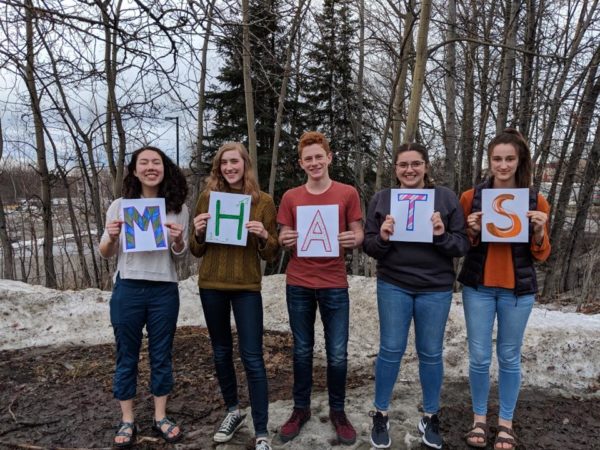
Mental Health Advocacy Through Storytelling (or MHATS) is a group of Anchorage high-school-age students who tell stories of mental health triumphs in order to combat the stigma surrounding mental illness and open up conversations.

Over ten meetings, we learn to tell true and personal 5-7 minute stories in the style of Arctic Entries/Storyworks/the Moth. We also learn advocacy skills– how to stand up for yourself and others. In addition to storytelling, in this session, we will be learning about what mental health education looks like in schools and advocating for House Bill 60, which would put K-12 mental health education into Alaska State law.

To learn more visit their website here. 

To register here:

https://forms.gle/RY8sQZqCX9KZytHTA 

Elizabeth Peratrovich Day!


Elizabeth Peratrovich, who played an instrumental role in the 1945 passage of the first anti-discrimination law in the United States. In 1941, after encountering an inn door sign that read “No Natives Allowed,” Peratrovich and her husband–both of Alaska’s Indigenous Tlingit tribe–helped plant the seed for the anti-discrimination law when they wrote a letter to Alaska’s governor and gained his support. 

Elizabeth Peratrovich—whose Tlingit name is Kaaxgal.aat, a member of the Lukaax̱.ádi clan of the Raven moiety—was born on July 4, 1911 in Petersburg, Alaska during a time of extensive segregation in the territory. She was lovingly raised by adoptive parents, living in various small Southeast Alaska communities throughout her childhood. With a passion for teaching, Peratrovich attended college in Bellingham, Washington where she also became reacquainted with her husband, Roy Peratrovich, who was a student at the same school. The couple married and moved to Klawock, Alaska where their role in local politics and Elizabeth’s knack for leadership drove her heavy involvement with the Alaska Native Sisterhood, one of the oldest civil rights groups in the world, leading to her eventual appointment as the organization’s Grand President. 

Seeking better access to lawmakers who could help effect change, the Peratrovichs moved in 1941 with their three children to the Alaskan capital of Juneau, where they were met with blatant discrimination. When attempting to buy a home in their new city, they were denied when the sellers saw they were of Alaska Native descent. Instances like these were unfortunately common for Alaska’s Indigenous peoples and further motivated Peratrovich to take action in the name of systemic change. 

Elizabeth and Roy worked with others to draft Alaska’s first anti-discrimination bill, which was introduced in 1941 and failed to pass. On February 5, 1945 following years of perseverance, a second anti-discrimination bill was brought before the Alaska Senate, and Peratrovich took to the floor to deliver an impassioned call for equal treatment for Indigenous peoples. She was met with thunderous applause throughout the gallery, and her moving testimony is widely credited as a decisive factor in the passage of the historic Anti-Discrimination Act of 1945.

In 1988 the Alaska State Legislature declared February 16 as “Elizabeth Peratrovich Day,” and in 2020 the United States Mint released a $1 gold coin inscribed with Elizabeth’s likeness in honor of her historic achievements in the fight for equality.

Thank you, Elizabeth Peratrovich, for helping to build the foundation for a more equitable future.


(Taken from Google Doodles)
Student Showcase – Jainy D.


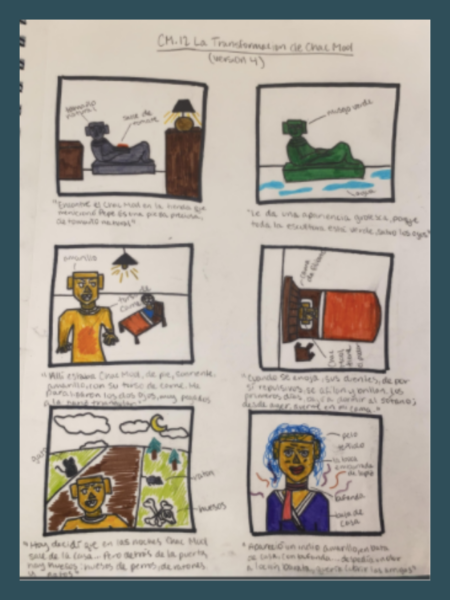
In Senior Spanish we read the magical realism story Chac Mool by Carlos Fuentes. Jainy interpreted the transformation of Chac Mool from statue to human using detailed drawings as described in the story and direct quotations that set the scene for the transformation.

Submitted by Ashley 

English/Spanish teacher

Beautiful work Jainy!